UOC hierarch assesses definition of ‘Russian world’ ideology in Law 8371
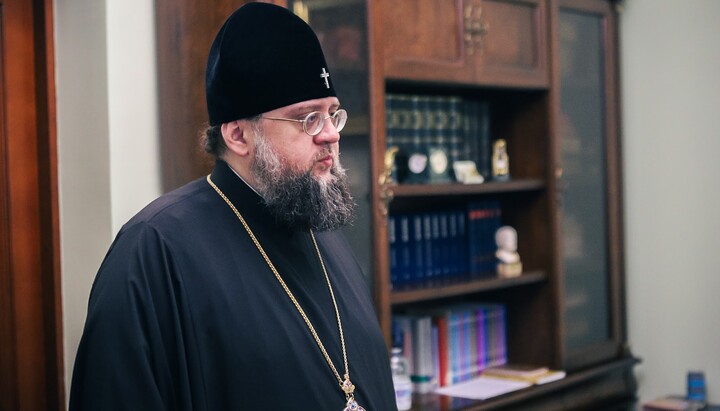
Archbishop Sylvester (Stoichev). Photo: KDAiS
Rector of the Kyiv Theological Academy and Seminary Archbishop Sylvester (Stoichev) in his commentary on Law No. 3894 “On the Protection of the Constitutional Order in the Sphere of Religious Organisations” (Bill No. 8371 at the stage of adoption – Ed.) drew attention to the vagueness of one of the important criteria by which the activities of religious organizations will be assessed, reports the KDAiS website.
“The new law provides for amendments to the law ‘On the prohibition of propaganda of the Russian Nazi totalitarian regime, armed aggression of the Russian Federation as a terrorist state against Ukraine, symbols of the military invasion of the Russian Nazi totalitarian regime in Ukraine’ of 22 May 2022 (No. 2265-IX) of the ‘Russian world’,” he writes.
By his conviction, the ‘Russian world’ doctrine serves today as one of the ideas of justification of the Russian armed aggression against Ukraine and therefore well deserves a direct ban.
However, the archbishop notes, the definition of the ‘Russian world’ ideology that is contained in Law No. 3894 is extremely broad.
“The ‘Russian world’ ideology is a Russian neocolonial doctrine based on chauvinistic, Nazi, racist, xenophobic, religious ideas, images and goals, the destruction of Ukraine, genocide of the Ukrainian people, non-recognition of the sovereignty of Ukraine and other states , pursuing the goal of Russian supranational imperial space as a way of realizing the special civilizational right of Russians to mass murder, state terrorism, military invasion of other states, occupation of territories, spreading the canonical territory of the Russian Orthodox Church beyond the territory of the Russian Federation,” he quoted the definition as saying.
Archbishop Sylvester emphasizes that it is possible to “fit an equally wide range of views and phenomena” under such a broad definition. He also points out certain logical inconsistencies.
“In particular, at the beginning of the sentence, the ideology of the ‘Russian world’ is labelled nationalist and racist, while further on it is stated that it aims to ‘expand the Russian supranational imperial space’.” “It is quite obvious that nationalism and ‘supranational imperial space’ are fundamentally different concepts that are difficult to unite within one doctrine,” he explains.
The hierarch states that the UOC has never supported or promoted the doctrine of the “Russian world”.
"No official document of the UOC contains either this phrase or this teaching. However, it is entirely possible that among the clergy of the UOC, there are adherents of the 'Russian world' ideology (in the form propagated by Patriarch Kirill). But I repeat once again, this is not and has never been the official position of the UOC. Moreover, if I’m not mistaken, even the ROC has never directly supported the doctrine of the Russian world in its official documents (statements and resolutions of Councils or the Holy Synod). This doctrine rather exists as a kind of 'personal project' of Patriarch Kirill. Additionally, as numerous researchers point out, it is quite difficult to consolidate Patriarch Kirill's various statements about the 'Russian world' into a single doctrine. Therefore, there are ongoing fierce debates among theologians and religious scholars about what exactly should be considered the teaching of the 'Russian world'. Consequently, one should be extremely cautious in drawing conclusions about this ideology," added the UOC bishop.
The fact that Law No. 3894 introduces the definition of the "Russian world" into Ukraine's legal framework could become grounds for banning a religious organization, even if it is not affiliated ROC.
"The criteria for defining this ideology seem extremely vague. I fear that this could lead to legal arbitrariness and selective justice...," concludes the rector of the Kyiv Theological Academy (KDA).
As reported by the UOJ, the KDA rector explained what to expect from the "UOC banning law".
Lexo gjithashtu
Në Vatikan u mbajt koncert në kujtim të Patriarkut Ilia II
Kori i Qendrës Shtetërore të Muzikës së Batumit dha një koncert solo në kishën e Shën Agathës, me diplomatë nga 30 vende dhe përfaqësues të diasporës gjeorgjiane.
Pse ortodoksët festojnë Lindjen e Krishtit në data të ndryshme
Dallimi mes kalendarit julian dhe atij gregorian prek lutjen, agjërimin dhe kujtesën e kishës, duke ngritur pyetje mbi unitetin ortodoks.
Kronika e takimit të Kievit 2018 rihap debatin kishtar ukrainas
Dokumenti i publikuar nga UOJ America dhe kundërshtimet kanonike të Kishës së Shqipërisë kërkojnë një lexim të kujdesshëm të fakteve dhe interpretimeve.
Kishat Lokale dyshojnë për hirotonitë e KOU-së pas deklaratës së Dumenkos
Kreu i KOU-së tha se nuk do ta pranojë kurrë mungesën e gradës, ndërsa disa Kisha Ortodokse Lokale ngrenë çështjen e vazhdimësisë apostolike të hirotonive.
Të rinj ndërprenë një meshë katolike në Vjenë duke thirrur “Allahu Akbar”
Famullitari tha se nuk pati rrezik dhe se bëhej fjalë ndoshta për gjallëri rinore, ndaj nuk do të bëjë denoncim në polici.
Radev dhe Patriarku Bartolome diskutuan rolin e besimit për unitetin shoqëror
Kryeministri bullgar tha se feja ortodokse ruan vlerat morale dhe bashkon shoqërinë, gjatë takimit me Patriarkun Ekumenik në prani të Patriarkut Daniel.