World Council of Churches turns to Stefanchuk due to a possible ban on UOC
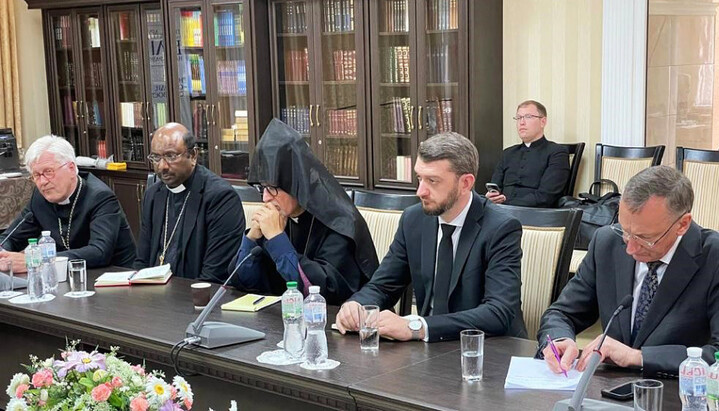
Meeting of the leadership of the WCC in Kyiv. Photo: AUCCRO website
Peter Prove, the Director of the Commission of the Churches on International Affairs at the World Council of Churches, sent a letter to the Speaker of the Ukrainian Parliament, Ruslan Stefanchuk, expressing the Council's "serious concerns" about the possibility of introducing bill 8371 into the parliamentary session, as reported by Strana.
Prove reminded that, according to the conclusion of the Scientific-Expert Office of the Parliament, the "language of the bill 8371 does not comply with constitutional requirements," and the "text of the bill has not been revised following this advisory opinion."
"We are deeply concerned that if adopted in its current form, without proper definition and limitations, this law could be used in ways that violate international norms of religious freedom or belief, and would be in contradiction with the stipulations of the National Security and Defense Council of Ukraine, which state that any such law should be 'in accordance with international norms of freedom of conscience and Ukraine's commitments in connection with joining the Council of Europe'," writes the Director of the Commission of Churches on International Affairs.
He also stated that the adoption of the bill "threatens to rupture social cohesion in Ukraine, especially at a time when that cohesion is critically necessary in the face of external threats to Ukraine's sovereignty."
The World Council of Churches believes that it is unacceptable to apply the principle of collective responsibility to religious organizations.
"Individuals who have committed treason or other crimes against Ukraine in the context of the Russian invasion must undoubtedly be held fully accountable under Ukrainian laws, through due legal process. However, banning or otherwise punishing the Ukrainian Orthodox Church (UOC) as a whole, without clear and public evidence that the Church itself poses a genuine threat to Ukraine's national security, would, in our view, be deeply divisive and counterproductive," writes Peter Prove. He also points out that "many members of the UOC are serving in the Armed Forces of Ukraine, and virtually all families connected with the Church, like all other Ukrainian families, have sons, brothers, parents, men, or other family members at risk in the defense of Ukraine from Russian aggression."
"For these reasons, we urge a fundamental rethinking of this legislation and at a minimum substantial revisions to address its deficiencies in accordance with Ukraine's constitutional obligations, its national interests in terms of unity and social cohesion, and its international commitments," concludes the representative of the World Council of Churches.
As previously reported by the UOJ, repressions against the UOC were discussed at an OSCE meeting.
Regene
Lexo gjithashtu
Arkeologët zbuluan në Jeruzalem ujësjellës që furnizonte Malin e Tempullit
Ujësjellësi i lashtë, ndërtuar nga Hasmonenjtë, sillte ujë nga burimet në jug të Betlehemit deri te Mali i Tempullit 2000 vjet më parë.
Deputetja e CDU-së paraqet ankesë ndaj emisionit të Böhmermann në ZDF
Caroline Bosbach i ka kërkuar Këshillit të Televizionit të ZDF-së të shqyrtojë shprehjet e Jan Böhmermann për Jezu Krishtin në emisionin „ZDF Magazin Royale“.
Në Vatikan u mbajt koncert në kujtim të Patriarkut Ilia II
Kori i Qendrës Shtetërore të Muzikës së Batumit dha një koncert solo në kishën e Shën Agathës, me diplomatë nga 30 vende dhe përfaqësues të diasporës gjeorgjiane.
Pse ortodoksët festojnë Lindjen e Krishtit në data të ndryshme
Dallimi mes kalendarit julian dhe atij gregorian prek lutjen, agjërimin dhe kujtesën e kishës, duke ngritur pyetje mbi unitetin ortodoks.
Kronika e takimit të Kievit 2018 rihap debatin kishtar ukrainas
Dokumenti i publikuar nga UOJ America dhe kundërshtimet kanonike të Kishës së Shqipërisë kërkojnë një lexim të kujdesshëm të fakteve dhe interpretimeve.
Kishat Lokale dyshojnë për hirotonitë e KOU-së pas deklaratës së Dumenkos
Kreu i KOU-së tha se nuk do ta pranojë kurrë mungesën e gradës, ndërsa disa Kisha Ortodokse Lokale ngrenë çështjen e vazhdimësisë apostolike të hirotonive.