Expert: Lack of recognition makes OCU seek new ways of survival
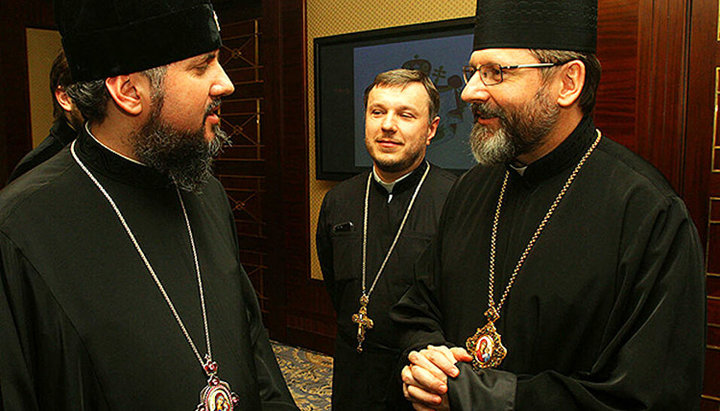
Head of the OCU Epiphany Dumenko and the head of the UGCC Sviatoslav Shevchuk. Photo: ria.ru
The allocation by the European Union of a grant for research on the ways of uniting the OCU and the UGCC is a necessary measure, which Epiphany Dumenko’s church structure resorted to due to the lack of full recognition by the Local Orthodox Churches and the people of Ukraine, says journalist Yuri Molchanov.
“Apparently, this is pushing the functionaries of the OCU to look for non-trivial ways to survive as a denomination. Even if these ways are to seek in the wilds of dubious geopolitics even if you have to integrate into the domestic political context and line up with devalued Ukrainian politicians. Or, finally, look for your place under the sun in the context of world ecumenism,” the “112.ua” channel cited Molchanov’s words.
The expert emphasized that any of the above 3 options "certainly will not make the OCU an attractive structure in the eyes of believers".
He also drew public attention to the fact that the task set by the initiators of the project to study the merger of the UGCC and the religious organization of Epiphany Dumenko was not entirely clear.
“The study of public and expert opinion or wider? For example, lobbyism, GR elements and the creation of communication and administrative channels to influence processes from abroad? In any case, this is a continuation of the line of the previous government, which, under the obvious patronage of international partners, got involved in dangerous experiments on redrawing the map of world Orthodoxy,” said Molchanov.
According to the political expert, in this situation, Ukraine is again forced to "play not its games" and be part of "global experiments in the religious world, in which the political establishment of the USA is primarily involved".
The expert also recalled that UGCC members are “primarily Catholics, albeit with Orthodox, Byzantine rites” but not Orthodox. Therefore, the structure in which they would merge with the OCU is a dubious institution.
“These are not branches of Orthodoxy that can argue among themselves for a long time about the canonical right to subjectivity, but nevertheless, they are practically unified in dogmatic and theological issues,” the journalist added.
As reported earlier, at the expense of grants allocated by the EU and with the support of the Phanar, the Institute for Foreign Policy Studies will study public opinion on the affiliation of the UGCC with the OCU.
Lexo gjithashtu
Në Vatikan u mbajt koncert në kujtim të Patriarkut Ilia II
Kori i Qendrës Shtetërore të Muzikës së Batumit dha një koncert solo në kishën e Shën Agathës, me diplomatë nga 30 vende dhe përfaqësues të diasporës gjeorgjiane.
Pse ortodoksët festojnë Lindjen e Krishtit në data të ndryshme
Dallimi mes kalendarit julian dhe atij gregorian prek lutjen, agjërimin dhe kujtesën e kishës, duke ngritur pyetje mbi unitetin ortodoks.
Kronika e takimit të Kievit 2018 rihap debatin kishtar ukrainas
Dokumenti i publikuar nga UOJ America dhe kundërshtimet kanonike të Kishës së Shqipërisë kërkojnë një lexim të kujdesshëm të fakteve dhe interpretimeve.
Kishat Lokale dyshojnë për hirotonitë e KOU-së pas deklaratës së Dumenkos
Kreu i KOU-së tha se nuk do ta pranojë kurrë mungesën e gradës, ndërsa disa Kisha Ortodokse Lokale ngrenë çështjen e vazhdimësisë apostolike të hirotonive.
Të rinj ndërprenë një meshë katolike në Vjenë duke thirrur “Allahu Akbar”
Famullitari tha se nuk pati rrezik dhe se bëhej fjalë ndoshta për gjallëri rinore, ndaj nuk do të bëjë denoncim në polici.
Radev dhe Patriarku Bartolome diskutuan rolin e besimit për unitetin shoqëror
Kryeministri bullgar tha se feja ortodokse ruan vlerat morale dhe bashkon shoqërinë, gjatë takimit me Patriarkun Ekumenik në prani të Patriarkut Daniel.