Nationalists picket the opening of the Orthodox Film Festival in Dnipro
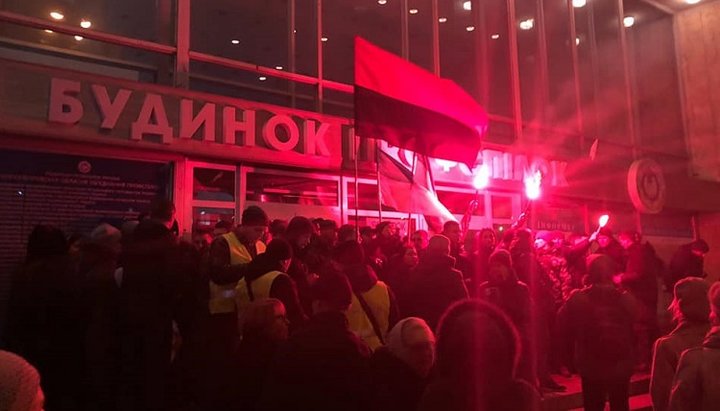
A picket at the House of Trade Unions in Dnipro. Photo: “Nashe Misto”
On January 30, 2020, on the opening day of the XI International Festival of Documentary Christian Films “The Film Assembly on the Dnieper”, organized by the “Lestvitsa” (Ladder) Orthodox Culture Centre, dozens of masked activists with fires and posters “No to the Russian world!” and “Freedom to the prisoners of the Kremlin” held a protest rally at the House of Trade Unions in Dnipro, reports “Radio Liberty”.
According to one of the activists, the protests were displeased with the fact that among the films participating in the festival there are “10 films made in Russia and only one is Ukrainian”.
“There are good Ukrainian films, for example, ‘Myth’ about a participant in the ATO, a famous opera singer,” the outlet quotes the activist. “But they are not offered for viewing. Before the start, there was a provocation: we were not allowed into the building by some “titushki” (men of strong built – Ed.). Just because we speak Ukrainian. The language is as an identifier,” she said.
The picketers, who were described by “Radio Liberty” as “representatives of public organizations, combat veterans in the Donbass, parents of the dead military, volunteers,” blocked the entrance to the House of Trade Unions, not allowing the spectators in, and demanded to present them film licenses. Also, some activists broke into the hall in order to "check whether the films contain pro-Russian propaganda" and "immediately after the announcement of the start of the festival, the Ukrainian anthem was sung".
At the same time, the local newspaper “Nashe Misto” specified that dozens of ultra-right-wing nationalists from the National Corps who “put on masks and burned fires” came to the House of Trade Unions.
In a commentary to “Radio Liberty”, the organizers of the Film Assembly emphasized that all films presented at the festival are outside politics. Among the participating pictures are films from Belarus, Georgia, Russia, Ukraine, Serbia, Armenia, and Azerbaijan.
“We are not here for this. We are talking about cinema, about directors, these are artists. We are not talking about war, because war is a topic that hurts everyone,” said Archpriest Igor Sobko, head of the “Lestvitsa” Orthodox Culture Centre.
We recall that the "International Film Assembly on the Dnieper" was first held in 2010. The main goal of the festival is to popularize documentary film art and create favorable conditions for the development of modern documentary cinema in Ukraine. In addition to film screenings, the festival also hosts meetings with filmmakers. The forum has long been a platform for communication between documentary filmmakers.
The opening film of the “Film Assemblies on the Dnieper – 2020” was a documentary “Our Beatitude” about the Primate of the Ukrainian Orthodox Church, Metropolitan Onuphry of Kyiv and All Ukraine.
Lexo gjithashtu
Mitropoliti Nikolla uroi Kishën Gjeorgjiane për 1700-vjetorin
Mitropoliti i Apolonisë dhe Fierit i uroi Patriarkun Shio III dhe veçoi veprën apostolike të Shën Ninës në letrën e datës 8 tetor 2026.
Patriarku i Gjeorgjisë Shio III uroi Patriarkun Bartolome për 35-vjetorin e fronëzimit
Patriarku i Gjeorgjisë falënderoi Patriarkun Ekumenik për mbështetjen ndaj Kishës gjeorgjiane, përfshirë letrën e dërguar gjatë luftës së gushtit 2008.
Kryeministri i Holandës Jetten përdor amësinë surrogate altruiste
Rob Jetten dhe partneri i tij Nicolás Keenan duan të bëhen prindër përmes një nëne surrogate; praktika jo-komerciale lejohet në Holandë me kushte.
Patriarku Joan X vizitoi presidentin libanez Joseph Aoun në Baabda
Patriarku i Antiokisë dhe mitropolitët e Sinodit të Shenjtë u takuan me presidentin libanez gjatë punimeve të mbledhjes së 16-të të Sinodit.
Gjykata në Kenia shpall fajtor pastorin e vetëshpallur Paul Mackenzie
Gjykata e Mombasës shpalli fajtorë edhe 28 bashkëpunëtorë të tij, ndërsa shpallja e dënimeve është caktuar për 6 nëntor 2026.
Patriarku Theodori II priti ambasadorin e Azerbajxhanit në Aleksandri
Në bisedë u trajtuan dialogu ndërfetar, bashkëjetesa paqësore e popujve dhe ftesa zyrtare për një vizitë të Patriarkut në Azerbajxhan.